|
Sage Wisdom - Noland (USA
Western)
by Commissioner Joe
Noland
Noland's entry is an excerpt from his book with co-author Dick
Hagerty,
WHAT IF? Dream BIG!
Chapter 10 – Mass Appeal
I’m intrigued by my co-writer's opening sentence in the
previous chapter:
“A dark cloud is quietly, steadily,
relentlessly moving…” It sounds a bit spooky, doesn’t it?
Especially when that dark cloud includes me, an old, decrepit,
graying octogenarian.
 Except
maybe it doesn’t include me, since I was forcibly retired from
active officership at age sixty-five, some twenty-three years
ago. I say "forcibly" because I had no choice in the matter,
which contradicts the covenant I signed upon
ordination. Except
maybe it doesn’t include me, since I was forcibly retired from
active officership at age sixty-five, some twenty-three years
ago. I say "forcibly" because I had no choice in the matter,
which contradicts the covenant I signed upon
ordination.
While I acknowledge that one can serve
Him supremely in retirement, that’s not specified in my
covenant. It doesn’t state, “…to love and serve Him supremely,
officially until retirement age, and then unofficially
thereafter.” No, it reads, “ALL MY DAYS.”
Interestingly, the phrase used to
describe the unofficial role is “retirement from active
officership.” That’s a bit contradictory, isn’t it? What’s the
alternative? Inactive officership? Inactive soul winner?
Inactive carer for the poor? Inactive feeder of the hungry?
Inactive clothier of the naked? Inactive lover of the
unlovable? Inactive befriender of those who have no friends?
What’s your point, Noland? My point is this: What
if retirement wasn’t an option? What if ageism wasn’t so
prevalent in the 21st century? What if we could close the gap
between the “graying of the clergy” and the “idealism of Gen
Z”? I asked ChatGPT to define “graying of the clergy,” and
this was the response:
“The ‘graying of the clergy’ refers to the growing trend of
clergy being older on average, with fewer young people
entering the ministry to replace those retiring. This is a
concern across many Christian denominations (and even in some
non-Christian traditions) since it impacts leadership
continuity, vitality, and the ability to connect with younger
generations.”
What if we could connect? What if we could combine
that idealism with our experience, and as role models,
actively emulate a life of service that is contemporary,
compelling, and appealing, rather than antiquated,
constraining, and uninviting?
What if we could reimagine the role of clergy to
focus on mission, innovation, and community engagement instead
of institutional maintenance? What if we could make it more
appealing to this emerging generation? What if we could dream
BIG?
Writing this has brought back a memory from the
1980s… I was the
General Secretary (second-in-command) of the Southern
California (SoCal) Division of The Salvation Army. It was my
responsibility, under the direction of the Divisional
Commander, to plan and execute our biannual Officer’s Councils
(Clergy Conference).
We always chose a venue that allowed
us to mix business with pleasure. That year, we convened at
the Disneyland Hotel, where a nearby performing arts theater
was featuring the iconic play, “Mass Appeal.” With the
Divisional Commander’s blessing, we booked an evening
performance as part of our itinerary. The show's message
perfectly captures the essence of closing that gap and
addresses all the "What if?" questions posed above.
What a serendipitous evening it turned out to be! The lively
discussions it generated fit perfectly with our council’s
theme and corresponding Scripture passage:
“I have become all things to all people so that by all
possible means I might save some” - 1 Corinthians
9:22.
The plot centers on a conflict between truth and compromise
within the Catholic Church, told through the relationship
between an aging, complacent priest and his idealistic,
rebellious seminary
student. The play
was later made into a movie, starring Jack Lemmon as a slick,
gifted Catholic priest responsible for a large parish. Into
his comfortable world comes a young, gifted, turbulent
seminarian on assignment. The two immediately clash, yet they
need each other. At one point, Jack Lemmon exclaims, “You must
be crazy! And the church needs crazies. You’re one of those
precious mavericks that comes along every so often and keeps
the church alive.”
What if we added a phrase to the Officer (Clergy) Covenant to
read:
“…befriend those who have no friends and champion those young,
precious cadet (seminary)
mavericks.”
Our seminaries and Schools for Officer Training (SFOTs) would
be filled to overflowing, attracting the masses—Mass Appeal!
And even this old, decrepit, graying octogenarian would be
willing to sign up all over again.
"There is no man that hath power over the spirit
to retain the spirit; neither hath he power in the day of
death: and
there is no discharge in that war;
neither shall wickedness deliver those that are given to it."
- Ecclesiastes 8:8
The overall solution? What if there was a cultural shift in
how ministry is valued, supported, and envisioned—not merely
focused on filling pulpits, but on nurturing sustainable and
diverse leadership that is future-oriented, regardless of age?
BREAKING NEWS!
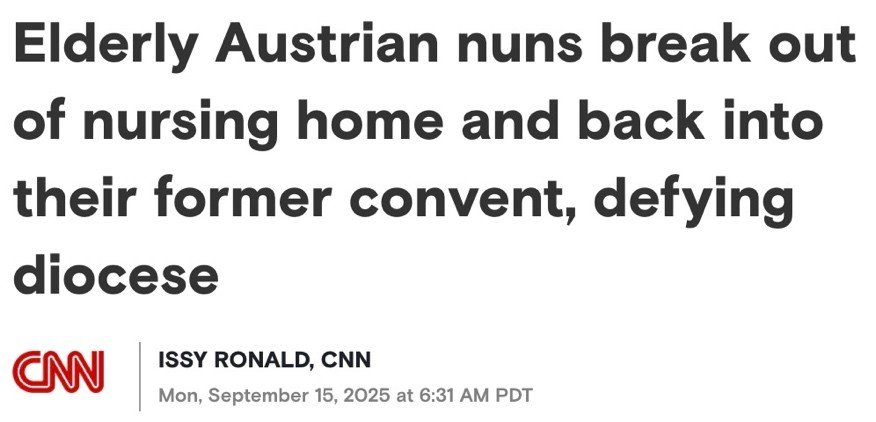
“Three octogenarian nuns have defied their diocese, run away
from their nursing home and returned to their former convent
in Salzburg, Austria, which they are now occupying.”
“On September 4, Sister Regina, 86, Sister Rita, 81, and
Sister Bernadette, 88, returned to Schloss Goldenstein, the
Alpine convent and girls’ school where they had spent most of
their lives — much to the displeasure of the local church.”
“The long-running dispute between the nuns and their superior,
Provost Markus Grasl, dates back to the end of 2023 when the
nuns say they were removed from the monastery against their
will.”
“The sisters’ former students have been helping and organizing
a daily routine for them, while a family doctor is available
to offer medical care.”
“Since returning to the convent, the nuns have become active
on Instagram, amassing more than 10,000 followers in little
over a week. On their account, they document their daily
routine of praying, eating and attending mass together as well
as their now-frequent interviews with journalists from all
around the world.”
Talk about messy, risk taking, and dreaming big. My new-found
heroes. And yes, I’ve connected with them on Instagram. Now,
that’s what I call…
Chapter 20 – Protect The Mission
Let me take “searching for solutions” in a
slightly different “What if?” direction. In doing so, I find
myself talking to myself more during these retiring
years—perhaps a symptom of aging. One playful question I often
ponder is:
“Noland, what if you had been born forty years
later?”
That would make me a youthful forty-eight today. I
not only ask the questions, but also answer them:
“Dreaming big, I would lust after one appointment
in particular.” (Yes, lust is the appropriate word).
“To command… No, wait! To be the CO
(coordinating/facilitating officer) of the Honolulu, Hawaii
Kroc Center.”
That’s the positive side of the conversation; now
comes the negative.
“Are you sure about that, Commissioner?” (Yes, I
address myself with this title. I earned it, and it makes me
feel important).
“Consider this: as a young, maverick officer, you
didn’t face the myriad legal constraints that exist today.
Back then, the legal department consisted of just one officer
and their administrative assistant. Now, it’s a whole gaggle
of attorneys, including HR, whose primary goal is to keep the
‘risk’ out of mission or as they so cleverly phrase it, to
'Protect the Mission.'”
My thoughts then begin to wander back to that
risk-filled era, and I wonder...
What if I could operate a Kroc Center without today's
all-consuming legal constraints? What if I could run a bus
ministry to reach children and families lacking access to our
programs? What if I could pack those kids into buses and vans
(60 kids in a 40-passenger bus, 15 in a 10-passenger van),
just like I once did, to get them all to church in a timely
manner?
Sunday School attendance in the thousands would be a given,
right? Junior Soldier enrollments would break historical
records, wouldn’t they? Ancillary youth outreach programs
would be pushing the boundaries, huh?
But alas! That’s not possible today. The lawyers
have taken over, stifling creativity and innovation. “Play it
safe” has become our standard operating procedure, negatively
impacting the growth of Sunday School and other outreach
programs, as churches and faith-based organizations must
navigate a complex web of laws while trying to engage children
and families.
Think about it. Had Wiilliam and Catherine Booth
attempted to birth The Salvation Army under these constraints,
they would have failed miserably.
In one territory, the “Protecting the Mission”
Policies and Procedures document is 23 pages long and requires
multiple signatures. That’s enough to scare the bejesus out of
anyone, isn’t it? Yes, I said “bejesus,” a colloquial
expression of Anglo-Irish origin, used to convey extreme
fright while avoiding invoking Jesus' name as an oath.
In my musings, two frightening memories often
surface. The first is of the old, rickety bus that DHQ loaned
us for Sunday school pickups in Flagstaff, Arizona. Due to the
number of children on any given Sunday, we had to limit it to
two rounds of pickups, each involving about sixty kids.
The bus had a seating capacity of only forty. What
to do? Dreaming big, we physically removed the seats to make
room for all sixty, seating them on the floor. It worked
without nary a mishap over that sixteen-month period.
Today, lawyers would have a conniption fit, and
after a warning or two, I’d receive that obligatory pink slip,
banishing me to the netherworld. Perhaps that’s a bit
dramatic, but ultimately, the corps and the Kingdom thrived!
Taking risks for the right reasons is essential to
the success cycle, even if it sometimes seems excessive in
hindsight. Risk-taking is inherently risky; you won’t always
get it right. However, in today’s legalistic culture, we would
eliminate risk altogether. When we do, the results speak for
themselves.
Look around. Do you see any Sunday Schools with an
average of 300 weekly attendees? At that Kroc Center, we could
easily attract 1,000 or more. That is, if we were operating
like we did forty years ago, rather than "Protecting the
Mission” from growth and expansion. Please don’t tell anyone I
said this but a more accurate title might be “Preventing the
Mission.”
The second scary memory leads us to our next
appointment in Phoenix, now a Kroc Center. Here’s how I
describe it in my book,
The Leadership Dilemma:
True story: For our groundbreaking ceremony, we wanted to take
a page out of that early day playbook where enormous risks
were taken to attract attention to the Gospel. That’s exactly
what the Broadway Youth and Family Center was all about, a
20th century model of that early day strategy.
The Territorial Commander would be there, along with local
dignitaries, the governor and mayor included. How to attract
the largest crowd possible to this open-air event? I’m not
sure where the idea came from, but I envisioned an airplane
flying over and dropping ping pong balls, those colored
yellow, red, and blue receiving a special prize, with those
lucky enough to nab the fire of the Holy Spirit (yellow), a
more substantial one. We saturated the community with flyers
advertising it.
It was very risky for several reasons: (1) The timing of the
drop had to be perfect taking into consideration the wind
direction. (2) There was no way of knowing how the crowd would
react (trample one another to get to the balls?). Thinking
about these things in the middle of the night, I almost
canceled the drop several times.
The attract attention ploy worked big time with a very large
crowd gathering at the designated hour. I instructed the pilot
to drop a test ball out in advance to see where the wind would
carry it. I waited and prayed.
The crowd was instructed. The airplane approached, everyone
waiting in anticipation. My heart was racing, body tensed,
nerves on edge. The ping pong balls were released. It was like
in slow motion, as they drifted across the road into the
neighbor’s yards. I watched in horror, as the mob ran across
the road, jumping over fences, trampling flower beds, bushes,
and everything else in their path to retrieve those balls. I
looked for the closest hole to crawl into.

Can you imagine that happening today? Approval requested,
please…

And what if I refuse to seek approval and decide to go ahead
anyway?
 Believe it or not, there is a happy ending to this story. Most of
that crowd became members of the center, many choosing The
Salvation Army as their church home, which statistically made
the divisional and territorial
coordinator
look good. Believe it or not, there is a happy ending to this story. Most of
that crowd became members of the center, many choosing The
Salvation Army as their church home, which statistically made
the divisional and territorial
coordinator
look good.

Hmm. What if we were to dream big and put the risk
back into mission?
|